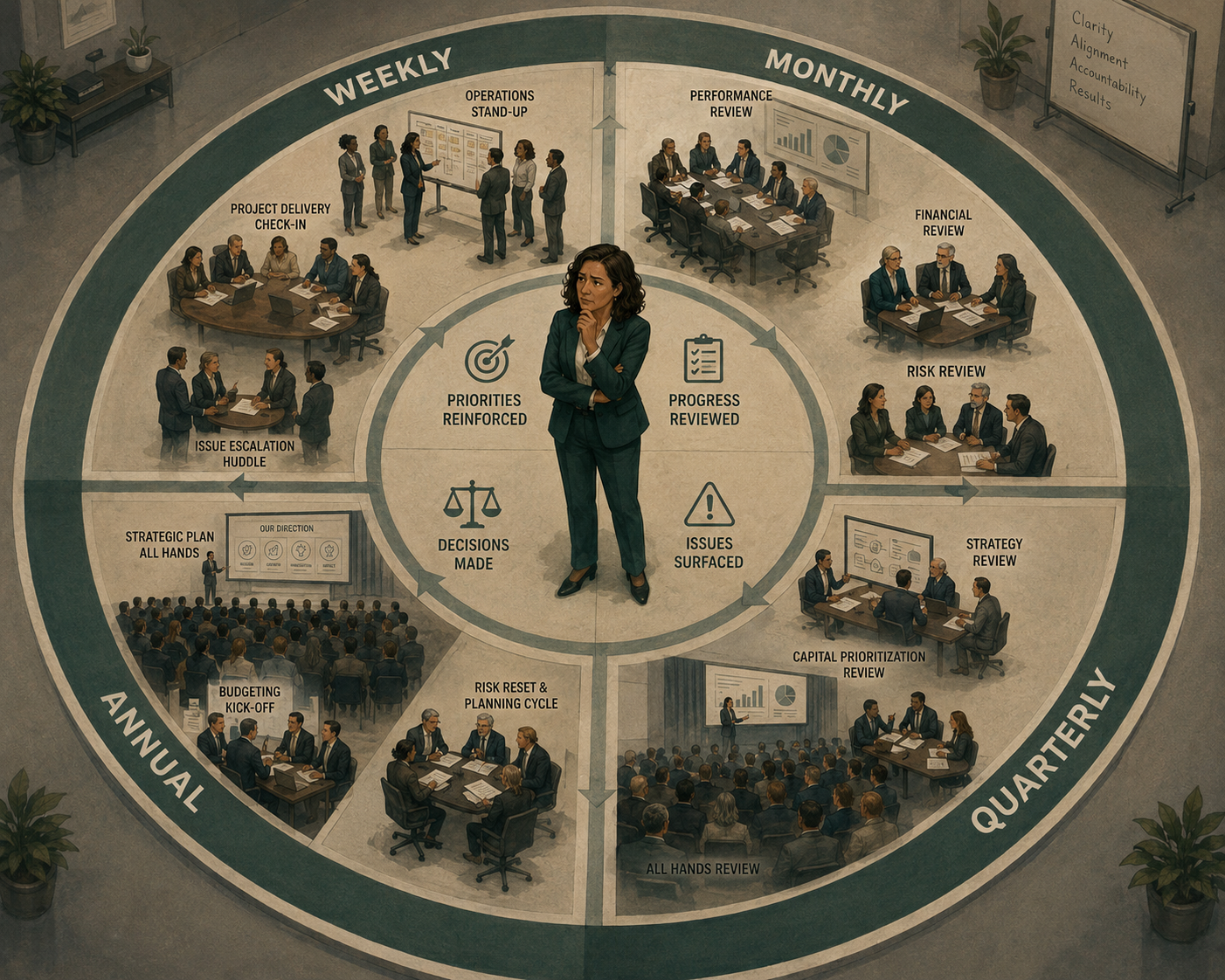
Sustained Scalable Impact Requires an Operating Rhythm
Energy systems are engineered to be judged under stress: peak load, the relief valve, the moment redundancy actually gets tested. Organizations should be designed the same way but rarely are.
Every organization has a rhythm: a deliberate cadence of recurring decisions, reviews, escalations, and learning. If governance is the skeleton( who decides, what they decide, who's accountable) the operating rhythm is the heartbeat. It's what turns authority into forward motion, at the frequency the work actually requires: weekly stand-ups that surface issues, monthly reviews that check progress, quarterly sessions that reset strategy and capital, annual planning that reinforces priorities.
Most rhythms aren't designed they accumulate. A forum gets inherited from a predecessor. A report survives the incident that created it. Nobody asks whether the whole system still produces the decisions the strategy now requires. Then pressure arrives and the rhythm is the first thing to break, one skipped meeting at a time.
This matters most where decisions cut across boundaries, which is exactly where energy investment lives. Facilities, finance, operations, and risk, all needing to trade off together. In our experience, energy strategies rarely fail on the technical merits. They fail organizationally first with unclear decision rights, a rhythm that collapses under the first hard quarter, no forum built to hold the trade-off.
The energy transition won't wait for organizations to catch up. Building a deliberate rhythm that can carry it is where sustained, scalable impact starts.